Why Every Expat in the UAE Needs a DIFC Will (And How to Get One)
If you are a non-Muslim living in Dubai, a DIFC Will is one of the most important legal documents you will ever sign. Yet the majority of expats in the UAE — even long-term residents with significant assets, still do not have one.
Why Every Expat in the UAE Needs a DIFC Will (And How to Get One)
Published by Blackstone Law UAE | Wills & Succession Planning Law
An expat couple has lived in Dubai for twelve years. They own an apartment in Dubai Marina, maintain joint bank accounts, run a small business together, and have two young children. One of them passes away suddenly. Within hours, every bank account — including the joint one — is frozen. The property cannot be touched. And a court, applying laws the couple never knew applied to them, begins dividing the estate according to rules they would never have chosen for their family.
This is not a rare worst-case scenario. It is the legal reality for thousands of expat families in the UAE every year — and it is entirely preventable.
If you are a non-Muslim living in Dubai, a DIFC Will is one of the most important legal documents you will ever sign. Yet the majority of expats in the UAE — even long-term residents with significant assets, still do not have one. This guide explains exactly why that matters, what the DIFC Will system actually does, and how straightforward it is to put one in place.
The Legal Reality Nobody Warns You About
The UAE is home to over 200 nationalities. The vast majority of Dubai's residents are expatriates, and most of them arrive without giving a second thought to what happens to their assets if they die here.
By default, when a non-Muslim expat dies in the UAE without a registered will, their estate is subject to UAE inheritance law — which is derived from Sharia principles. In the absence of a registered will, bank accounts and assets will remain frozen until instructions are received from a UAE Court, and all debts of the deceased in the UAE are cleared first.
Recent legal reforms have improved the situation for non-Muslims to some degree. Under Federal Decree-Law No. 41 of 2022 on Civil Personal Status, if a non-Muslim expatriate dies without a valid will, the default distribution is now fixed at 50% of the estate to the surviving spouse and 50% divided equally among children regardless of gender.
But it still removes all flexibility — your actual wishes become legally irrelevant. You cannot leave assets to close friends, charitable causes, step-children, or other people who matter to you. You cannot specify how your business is handled. And you cannot choose who raises your children. Only a registered will gives you that control.
What Is a DIFC Will — and Why Is It Different?
The Dubai International Financial Centre (DIFC) Wills Service is a joint initiative of the Government of Dubai and the DIFC Courts. It was established by Resolution No. 4 of 2014 and its authority was reaffirmed by Dubai Law No. 15 of 2017, specifically to regulate inheritance, wills, and probate for non-Muslims.
In plain terms, a DIFC Will places your estate outside the default Sharia-based system and into an internationally recognised, English-language framework.
A landmark legal development has made DIFC Wills even more powerful in 2025. Dubai Law No. 2 of 2025 grants DIFC-registered wills exclusive jurisdiction and direct enforcement for assets located in Dubai.
For broader estate planning and inheritance legal support, visit our Wills & Succession Planning practice area.
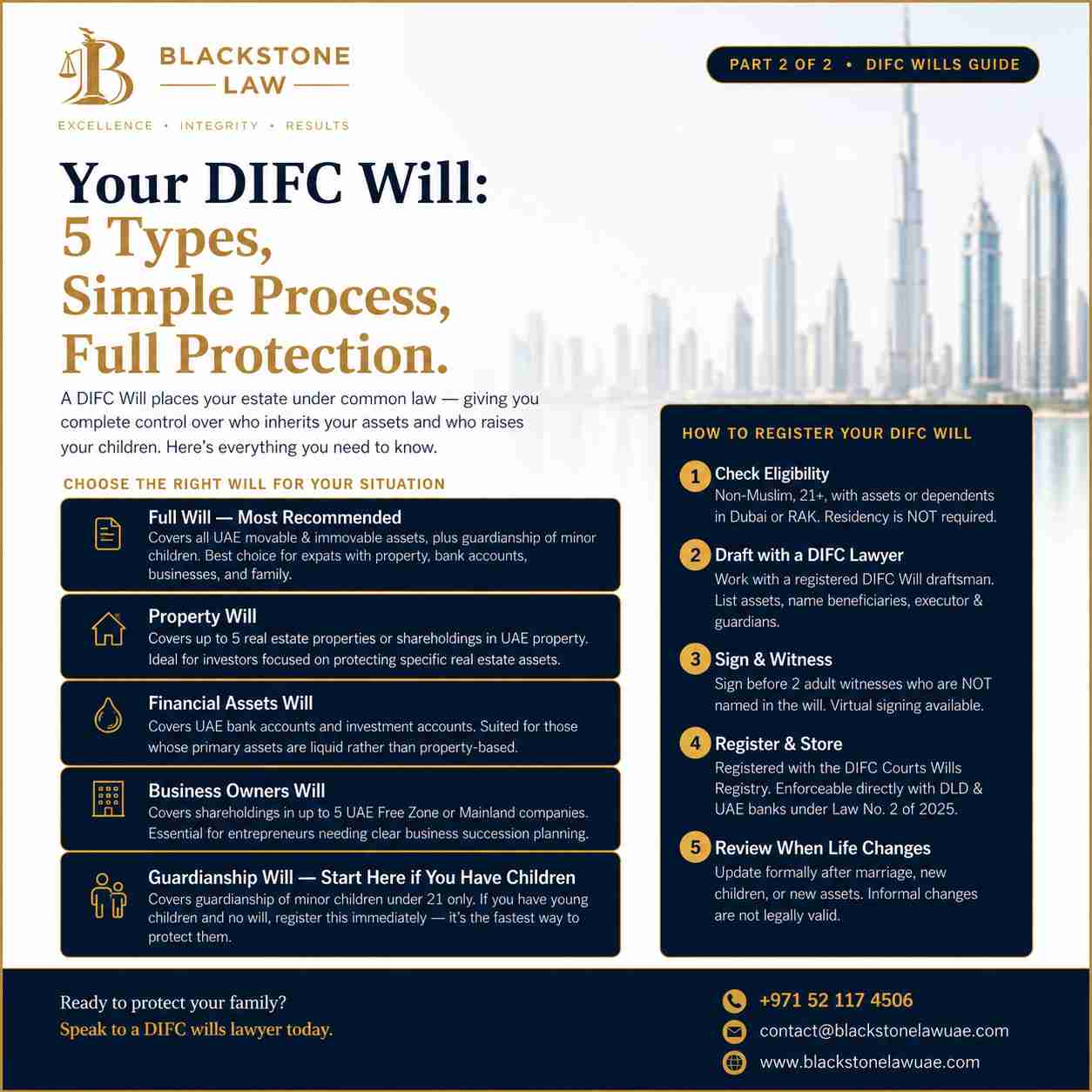
The Five Types of DIFC Wills — Which One Do You Need?
Full Will
The Full Will is the most comprehensive option and the right choice for most expats. It covers the distribution of all your movable and immovable property in the UAE and also allows you to appoint interim and permanent guardians for your minor children residing in Dubai or Ras Al Khaimah.
Property Will
The Property Will applies to up to five specific real estate properties or shareholdings in UAE real estate.
Financial Assets Will
The Financial Assets Will covers bank accounts and investment accounts, making it useful for those whose primary UAE assets are liquid rather than property-based.
Business Owners Will
The Business Owners Will addresses shareholdings in UAE-based Free Zone or Mainland companies — up to five shareholdings.
Guardianship Will
The Guardianship Will only covers guardianship of minor children under the age of 21 living in the UAE.
The DIFC system has also introduced a Digital Assets Will — a forward-looking option that allows testators to plan for digital holdings including cryptocurrency stored in non-custodial wallets.
The Real Cost of Not Having One
People often assume that because they are young, healthy, or have a will "back home," they are covered in the UAE. None of these assumptions hold up under local law.
A foreign will — whether British, American, Australian, or otherwise — is not automatically enforceable in the UAE.
Immediate Asset Freeze
As soon as authorities are notified, personal and even joint accounts can be blocked until legal procedures are completed.
Loss of Control Over Distribution
Without a registered will, the court decides who gets what.
Guardianship Uncertainty
Without a registered will specifying guardianship, the court may assign care for minor children based on local rules.
Business Disruption
Without proper succession planning, the smooth transfer of business ownership can be jeopardised.
How the Registration Process Works
Eligibility
You must be non-Muslim and at least 21 years old. You should have assets in Dubai or Ras Al Khaimah — including property, bank accounts, or shares.
Drafting
Drafting should be done with the assistance of a qualified wills lawyer in Dubai who is registered with the DIFC Wills Service's Register of Will Draftsmen.
For legal assistance related to inheritance planning, estate structuring, and succession matters, you can also explore our Corporate & Business Law services.
Execution and Registration
Execution and registration requires signing the will in the presence of two adult witnesses who are not named as beneficiaries in the document.
The DIFC Wills Service Centre also offers a Virtual Registry, enabling registration through secure video conference.
Cost
Single will registration through the DIFC system starts at approximately AED 10,000.
Updates and Amendments
A DIFC Will is not a set-and-forget document. Life changes — marriages, divorces, additional children, new properties — all warrant a formal review and update.
Mirror Wills: The Smart Choice for Couples
For married couples or civil partners, the DIFC system offers mirror wills — two complementary wills that reflect each other's intentions.
DIFC Versus Dubai Courts: Knowing the Difference
Some expats are aware that it is possible to register a will through the Dubai Courts Notary Public system at a lower cost.
Dubai Courts wills are processed in Arabic under civil law. Non-Arabic-speaking beneficiaries and executors will likely require professional legal assistance during probate.
For most non-Muslim expats with meaningful UAE assets, the procedural advantages, English-language process, and enforcement certainty of the DIFC route make it the clearly superior long-term choice.
You can review more information directly through the official DIFC Courts Wills Service.
Take Control of Your Legacy Today
Estate planning is not something most of us want to think about. But for expats in the UAE, it is not a luxury — it is a necessity.
At Blackstone Law UAE, our wills lawyers in Dubai work with non-Muslim expats across all asset types and family circumstances — from straightforward residential will registrations to complex multi-jurisdictional estate plans involving property, businesses, and cross-border assets.
We walk you through every step of the process, from initial consultation to final registration, and ensure your DIFC Will is properly coordinated with your wider international estate plan.
Contact Blackstone Law UAE today for a will registration consultation. The call takes minutes. The protection lasts a lifetime.
Frequently Asked Questions
Do expats in Dubai need a DIFC Will?
Yes. A DIFC Will helps non-Muslim expats ensure their UAE assets and guardianship wishes are distributed according to their instructions instead of default inheritance laws.
Can a foreign will be used in the UAE?
A foreign will is not automatically enforceable in the UAE and may still require UAE court interpretation or additional legal procedures.
How much does a DIFC Will cost?
DIFC Will registration generally starts from around AED 10,000, with total drafting and registration costs often ranging between AED 13,000 and AED 15,000.
Can DIFC Wills cover UAE property and bank accounts?
Yes. DIFC Wills can cover UAE real estate, bank accounts, investments, business interests, and guardianship of children depending on the will type selected.
Blackstone Law UAE | Wills & Succession Planning Law | Dubai, United Arab Emirates
Call & WhatsApp: +971 52 117 4506 | Email: contact@blackstonelawuae.com | Website: www.blackstonelawuae.com
Disclaimer: This article is intended for general informational purposes only and does not constitute legal advice. Laws and regulations are subject to change. Please consult a qualified legal professional regarding your specific circumstances.