What Happens to Your Assets in the UAE If You Die Without a Will
When a person dies without a valid will in the UAE, they are said to have died intestate. This is not simply the absence of a document.
Wills & Succession Planning | Published by Blackstone Law UAE
What Happens to Your Assets in the UAE If You Die Without a Will?
It is a question most people living in the UAE never stop to ask — not because they do not care about their families, but because death feels distant and the present demands enough attention on its own. The mortgage, the school fees, the business targets. The idea of sitting down with a lawyer to plan for what happens when you are gone always feels like something for later.
But for the hundreds of thousands of expatriates living and working in the UAE, "later" carries a very specific legal price tag. The UAE has a defined, court-driven process for dealing with the estates of people who die without a will in the UAE. It does not wait for grief to pass. It does not defer to what your family knows you would have wanted. And in many cases, the outcome is nothing like what any reasonable person would have planned for their loved ones.
This article explains — clearly and honestly — what UAE inheritance law actually does to your assets when you die without a registered will, why the process is more disruptive than most people realise, and what succession planning steps are available to take control before it is too late.
Understanding "Intestate": The Legal Condition Nobody Talks About
When a person dies without a valid will in the UAE, they are said to have died intestate. This is not simply the absence of a document. It is a legal condition that triggers a formal judicial process — one that transfers all decision-making about your estate from your family to the courts.
The absence of a valid will does not create a legal vacuum. It triggers a defined statutory process that removes all discretion from your family and places it firmly in the hands of the court.
For non-Muslim expatriates, this triggers a formal inheritance process under Federal Decree-Law No. 41 of 2022 on Civil Personal Status. In the absence of a registered will, the UAE Personal Status Courts assume jurisdiction over the deceased's estate. What follows is a process that most families — already in the depths of bereavement — are entirely unprepared for.
Step One: Everything Freezes Immediately
The first and most immediately devastating consequence of dying intestate in the UAE is the freeze on assets.
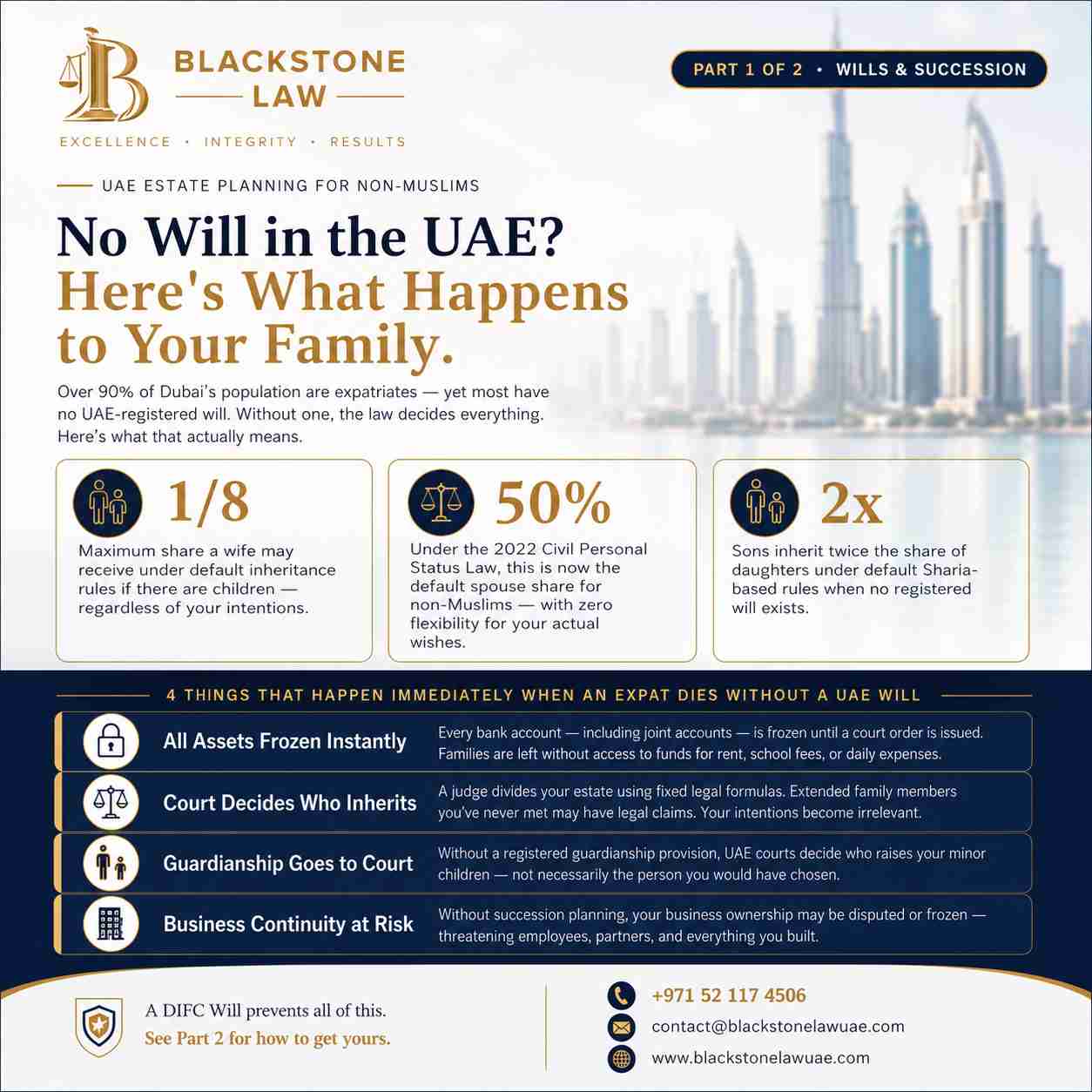
All assets are frozen upon death — including bank accounts and jointly held properties — until a court order authorises their release. Even if one spouse jointly owns property or an account, they cannot access or transfer it without completing probate. Banks are legally obligated to block access to the deceased's accounts until they receive a succession or probate order.
Read that again: joint accounts. The account you share with your spouse — the one you have been paying into together for years — is frozen. Your spouse cannot access it. Not for rent. Not for grocery bills. Not for school fees. Not while the court process unfolds.
Unlike the streamlined probate process available to those with a registered DIFC will — which can often conclude within 2–4 months if uncontested — dying intestate in the UAE can mean a probate timeline of 6 to 18 months or longer, especially if asset ownership is complex or if heirs are located abroad.
What the UAE Probate Court Process Actually Looks Like
Once an intestate death is registered, the family — or their legal representative — must navigate a formal court procedure to access any part of the estate. There is no shortcut, and there is no one assigned automatically to help them through it.
The family must submit:
- The death certificate
- Identity documents of all heirs
- Proof of family relationships
- Proof of all UAE-held assets
- Any foreign documents — legalised and officially translated into Arabic
A formal inheritance case must then be filed. The court issues an inheritance order — the document required to actually release assets. In expatriate cases, the embassy or consulate of the deceased's home country must also be contacted for further formalities.
Funeral expenses and debts must be extracted from the estate first, in accordance with Article 201 of Federal Decree-Law No. 41 of 2024 (Personal Status Law). Critically, there is no automatic executor in UAE intestacy cases. The court appoints an estate administrator — a formal judicial appointment, not an immediate one — leaving the family without a designated decision-maker during a deeply vulnerable period.
For complex or contested estates, engaging specialist estate administration and probate lawyers in Dubai from the outset significantly reduces delay and cost.
How UAE Law Divides Your Estate: Muslim and Non-Muslim Rules
This is where UAE succession law becomes particularly important to understand, because the rules differ significantly depending on your religion.
For Muslim Residents
Muslim residents are subject to fixed-share Sharia inheritance distribution, irrespective of nationality. Under Sharia, a wife receives one-eighth of her husband's estate if children exist, or one-quarter if there are none. Sons typically receive twice as much as daughters.
A Muslim individual may only distribute up to one-third of their estate by will to people outside the prescribed heirs — the remaining two-thirds follows fixed formulas regardless of personal preference. Even a carefully drafted will cannot override the core Sharia inheritance shares for primary heirs.
For Non-Muslim Expatriate Residents
The legal landscape for non-Muslim expats in the UAE has changed substantially. Under Federal Decree-Law No. 41 of 2022, effective 1 February 2023, Sharia principles no longer apply by default to non-Muslim intestate estates.
Now, the surviving spouse receives 50% of the estate, and the remaining 50% is divided equally among children regardless of gender. This is a meaningful improvement from the previous default, under which a wife could receive as little as one-eighth.
However, the improved default still removes all flexibility. You cannot leave anything to a close friend. You cannot specify that your business partner receives your shareholding. You cannot leave a bequest to a stepchild, sibling, or a charity. You cannot choose your children's guardian. The court applies the statutory formula, and your individual intentions become legally irrelevant.
The law allows non-Muslims to have their assets handled under home country law — but this requires a formal court application with supporting documentation, at a time when your family is already dealing with grief and a frozen estate. A registered UAE will drafted by an experienced wills lawyer removes this uncertainty entirely.
The Guardianship Question: Who Raises Your Children?
For parents of minor children, dying intestate in the UAE raises a question that goes far beyond money: who will care for your children if you die?
UAE law distinguishes custody from guardianship. Custody (day-to-day care) is typically granted to the mother. Guardianship (financial and legal responsibility) is commonly vested in the father. When a father dies intestate, the question of who assumes guardianship is determined by the court — not by the family.
Without a registered guardianship provision in a will, a court may appoint a guardian based on local legal principles that may not align with your wishes. For families with international backgrounds, this uncertainty is particularly acute.
A registered guardianship will for minor children in the UAE — specifically a DIFC Will with a guardianship provision — is the only legally binding way to ensure your children are cared for by the person you trust.
What About Your UAE Business Interests?
Many expats in the UAE hold stakes in Free Zone companies, mainland LLCs, or other business structures. These assets do not escape the intestacy process.
Without a registered will, UAE business assets fall under local succession law, not home country rules. A business you built can be frozen, disrupted, or disputed while probate proceedings play out. Partners, employees, and clients are all affected by the uncertainty.
A Business Succession Plan under the DIFC framework specifically addresses the transfer of company shareholdings — allowing you to designate who takes over, on what terms, and without a contested court process running in parallel with ongoing business operations.
If your estate includes significant corporate assets, our corporate legal services team works alongside our wills team to ensure seamless continuity of ownership.
The Risk of Relying on a Foreign Will
Many expats assume that having a will registered in their home country — the UK, Australia, Germany, India, the US — protects their UAE assets. This assumption is dangerously unreliable.
A standard foreign will drafted abroad and not registered in the UAE may not be automatically recognised. If a foreign resident dies with only an unregistered overseas will, the UAE court may treat the estate as having no will at all — sweeping everything into the intestate process with all the delays, freezes, and inflexibility that entails.
Translation requirements, legalisation procedures, and judicial interpretation all introduce uncertainty that a locally registered will eliminates entirely. This is not a technicality — it is a risk with real financial and human consequences for your family.
The Practical Difference a UAE Will Makes
The contrast between dying intestate and dying with a registered UAE will is not subtle — it is dramatic, at every stage of the process:
- Probate can conclude in weeks rather than months
- An executor you trusted is named and empowered from the moment of death
- Your beneficiaries receive exactly what you intended
- Your business interests transfer on terms you dictated
- Your children's guardians are who you chose
- Your surviving spouse is not left stranded without access to funds
The UAE imposes no inheritance tax. The cost of a registered DIFC Will — typically between AED 13,000 and AED 15,000 including legal drafting — is the primary financial cost of comprehensive succession planning for most expat families. Measured against the cost of a contested, multi-month court process, it is not a difficult calculation.
Your Succession Planning Options in the UAE
DIFC Wills Service (Dubai)
The most comprehensive option for non-Muslim expats in Dubai and Ras Al Khaimah. Offers Full Wills, Property Wills, Business Owners Wills, Financial Assets Wills, and Guardianship Wills — all enforceable directly with the Dubai Land Department and UAE banks under Dubai Law No. 2 of 2025. Virtual registration is available for non-residents with UAE assets.
Abu Dhabi Judicial Department (ADJD)
The equivalent registration body for non-Muslims with assets primarily located in Abu Dhabi — a legally recognised alternative to the DIFC for those whose interests are centred in the UAE capital.
Dubai Courts Notary Public
A lower-cost option (approximately AED 2,167) for basic UAE will registration. Arabic-language process. For non-Arabic-speaking families, probate proceedings may be more complex than the DIFC route.
For Muslim Residents
A will can still be registered to direct the discretionary one-third of the estate, coordinate with overseas assets, appoint an executor, and provide guidance on guardianship for minor children within the bounds of Sharia law.
Frequently Asked Questions: UAE Wills and Intestacy
What happens to my bank account if I die without a will in the UAE?
Your bank account — including any joint accounts — is frozen immediately upon your death. Banks are legally required to block access until the UAE court issues a formal succession or probate order. This process can take 6 to 18 months for intestate estates, leaving your family without access to funds in the interim.
Can a foreign will protect my UAE assets?
Not reliably. A will drafted and registered abroad is not automatically recognised by the UAE courts. Without a locally registered will, the UAE may treat your estate as intestate regardless of your overseas document — triggering the full court-driven distribution process.
Do UAE inheritance laws apply to expats?
Yes. All assets located in the UAE — property, bank accounts, business shareholdings — are subject to UAE succession law regardless of the owner's nationality. For non-Muslims, Federal Decree-Law No. 41 of 2022 now applies a 50/50 split between spouse and children by default, but this still removes your ability to direct assets as you choose.
How much does a DIFC will cost in Dubai?
Total costs typically range from AED 13,000 to AED 15,000, including legal drafting, review, and DIFC registration fees. This is a one-time cost that provides comprehensive legal protection for your entire UAE estate.
Who becomes guardian of my children if I die without a will in the UAE?
The UAE court determines guardianship, which may not align with your wishes. A registered guardianship will is the only legally binding method to appoint the guardian of your choice for your minor children in the UAE.
The Only Question That Matters
At Blackstone Law UAE, we work with expats every day who have spent years building their lives here — careers, properties, businesses, families — without ever sitting down to answer one fundamental question: what happens to all of this if I am not here?
Succession planning in the UAE is not complicated, and it does not have to be expensive. Our wills and succession planning team helps clients across Dubai and the wider UAE assess their estate, choose the right type of will, draft and register it correctly, and ensure it works in concert with any international estate planning they may already have in place.
A registered will is not a morbid exercise. It is an act of love for the people you are leaving behind — a decision that the chaos of court proceedings and frozen accounts will not be the thing your family remembers about you.
Contact Blackstone Law UAE today for a confidential succession planning consultation.
Let us help you make sure your wishes are the ones that count.
Book a Free Consultation WhatsApp UsDisclaimer: This article is intended for general informational purposes only and does not constitute legal advice. Laws and regulations are subject to change. Please consult a qualified legal professional regarding your specific circumstances.
Blackstone Law UAE | Wills & Succession Planning | Dubai, United Arab Emirates | www.blackstonelawuae.com