Dubai Title Deed Problems: Issues & Legal Solutions | BL UAE
The six most common title deed problems in Dubai — delayed transfers, undisclosed encumbrances, errors and ownership disputes — and the legal steps to resolve each one.
Real Estate & Property Law | Published by Blackstone Law UAE
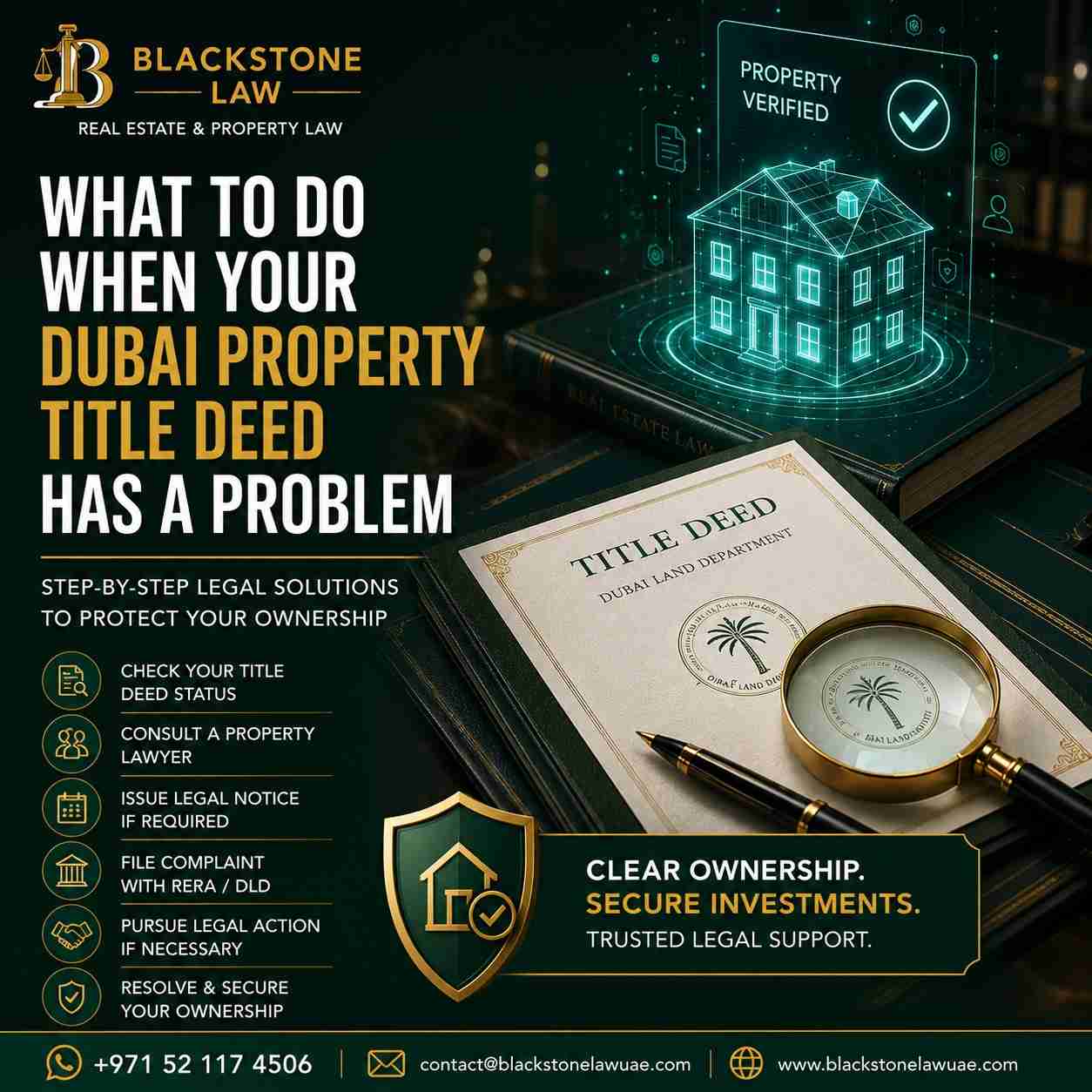
Title Deed Issues in Dubai: Common Problems and Legal Solutions
You paid every instalment on time. The developer handed over the keys on schedule. You moved in, renovated, and started calling it home. Then — sometimes a year later, sometimes three — you discover a problem with your title deed. The property you believed was fully and cleanly yours turns out to have an encumbrance registered against it. Or the measurements on the title deed do not match the actual unit. Or the developer has not transferred the title deed at all, despite receiving full payment.
Title deed problems in Dubai are more common than most buyers realise — and they are almost universally more expensive to resolve the longer they go unaddressed. In 2024, approximately 10% of property sales in Dubai encountered snags over unclear or disputed deeds. In a market where AED 761 billion in real estate transactions were recorded in the same year, even a small percentage translates into a significant number of real families and investors facing real legal problems.
This article explains the most common title deed issues in Dubai, what the law says about them, and what steps to take if your property ownership documentation is not as clean as it should be.
What a Title Deed Actually Is — and Why It Matters
The title deed is the official document issued by the Dubai Land Department (DLD) that confirms legal ownership of a property. It is essential for all real estate transactions under Law No. 7 of 2006 Concerning Real Property Registration in the Emirate of Dubai. Without a clean, registered title deed, you cannot legally sell the property, mortgage it, transfer it to a family member, or use it as collateral.
In 2025, the DLD launched a blockchain-based registry for secure ownership records — an upgrade that makes fraudulent title deeds significantly harder to produce and distribute. Despite this, title deed problems arising from historical transactions, developer errors, and administrative oversights continue to create serious difficulties for property owners across the emirate.
A title deed problem is not always immediately visible. Some encumbrances only come to light when you attempt to sell, refinance, or transfer the property. Others surface during a divorce, estate settlement, or when a creditor seeks to enforce a judgment against an asset. The most dangerous title deed issues are the ones you do not know about — until they become urgent. This is why legal due diligence before any property purchase is essential, not optional.
The Six Most Common Title Deed Problems in Dubai
1. Delayed Title Deed Issuance by the Developer
For off-plan purchases, the Oqood certificate registers your interim ownership during construction. The final title deed should be transferred to your name once the project is completed and you have paid in full. Disputes arise when developers delay title deed issuance after receiving full payment — sometimes by years. These delays prevent you from selling the property, refinancing it, or transferring it to heirs.
The legal position is clear: under the SPA and Dubai property law, the developer is obligated to process the title deed transfer promptly upon full payment and handover. A developer who withholds or delays this process without valid reason is in breach of their contractual and statutory obligations. A property lawyer can issue a formal legal notice to the developer, file a complaint with RERA, and if necessary pursue the matter through the DLD or Dubai Courts to compel the transfer. Our off-plan property and developer disputes team handles exactly these situations.
2. Undisclosed Encumbrances and Mortgages
Buyers sometimes discover their property is subject to undisclosed encumbrances: mortgages registered by the developer against the project, unpaid contractor liens, service charge arrears, or court orders affecting the property. These encumbrances can prevent property transfer or create unexpected liability for the buyer.
Comprehensive due diligence before purchase identifies most encumbrances — but some are deliberately concealed or arise late in the transaction. If you purchase a property and later discover an undisclosed encumbrance, you may have grounds for a claim against the seller for breach of contract or misrepresentation. The process for removing a registered encumbrance typically requires either satisfying the underlying obligation or obtaining a court order declaring the encumbrance invalid or discharged.
3. Title Deed Errors and Discrepancies
Administrative errors in the title deed — incorrect owner name, wrong unit number, inaccurate measurements, or discrepancies between the deed and the actual registered property — create complications for every downstream transaction. A title deed that shows a different area than the actual unit can affect your ability to obtain a mortgage, set a sale price, or comply with building regulations.
DLD-administered surveys and the correction process under applicable federal and local property laws provide a mechanism for rectifying errors. A property lawyer guides the correction process — which typically requires a formal application to the DLD, supporting documentary evidence, and potentially a physical survey report.
4. Ownership Disputes and Competing Claims
Ownership disputes can arise from several directions: fraudulent sales where a property is sold without the true owner's knowledge, inheritance disputes where multiple heirs claim entitlement, or disputes between business partners who co-own property and disagree on its management or disposition.
Challenging fraudulent title deeds under Dubai property law requires formal court proceedings. Collecting evidence — contracts, inspection reports, ownership records, and all communications — is essential. Dubai Courts will appoint experts to review technical claims, and the resolution process, while rigorous, provides a definitive judicial outcome. Acting quickly matters: the longer a fraudulent title remains unchallenged, the more complex the legal position becomes if the property has subsequently been sold to an innocent third party. Our property disputes and litigation team handles contested ownership proceedings at every level.
5. Service Charge Arrears from the Previous Owner
Service charge disputes arising from the previous owner's unpaid arrears create problems for new buyers who fail to verify the full payment position before completing their purchase. Under the Jointly Owned Property Law (Law No. 6 of 2019), community management companies have the right to pursue service charge arrears — and in some circumstances, this liability may attach to the property rather than simply the individual.
A No Objection Certificate (NOC) from the master developer, confirming all service charges are cleared, is mandatory before any resale transfer at the DLD trustee office. A buyer who completes without this check inherits the previous owner's obligations. If you have already completed and subsequently discovered outstanding service charges, your remedy lies against the seller — either through the SPA indemnity provisions or a direct claim for misrepresentation.
6. Problems with Jointly Owned or Shared Title Deeds
For properties owned by two or more parties — business partners, married couples, or family members — the title deed specifies each party's ownership share. Disputes arise when one co-owner seeks to sell or mortgage their share without the other's consent, when the ownership percentages are disputed, or when the property needs to be divided following a relationship breakdown.
UAE property law generally requires co-owner consent for any disposition of jointly owned property. If co-owners cannot agree, an application to the courts for a formal partition or forced sale may be necessary. Our co-ownership agreement drafting service prevents many of these disputes from arising by properly documenting each party's rights and obligations at the outset.
How to Verify Your Title Deed is Clean
The DLD's Dubai REST app provides real-time verification of property ownership status. A formal encumbrance and ownership search through a licensed property lawyer provides a more comprehensive picture — covering registered mortgages, court orders, RERA flags, and service charge history.
For any property purchase, whether resale or off-plan, these checks should be completed before any payment is made. For properties you already own, a periodic ownership verification is advisable — particularly before any major transaction or life event such as estate planning, refinancing, or business restructuring.
What to Do When You Discover a Title Deed Problem
Act quickly. Title deed problems rarely resolve themselves, and delay typically makes them more complicated and expensive to address. The moment you discover a potential issue — an encumbrance, an error, a competing claim, or a withheld transfer — take legal advice.
Gather all documentation. Your SPA, payment receipts, all correspondence with the developer or seller, the Oqood certificate if applicable, and any notices or communications you have received are the foundation of your legal position. The DLD formally requires all supporting documents to be submitted as part of any title deed correction or dispute application.
Verify before escalating. Sometimes what appears to be a title deed problem is an administrative error that can be corrected without formal dispute proceedings. A property lawyer identifies which category your problem falls into and advises on the most efficient route to resolution — whether that is a DLD administrative correction, a RERA complaint, a negotiated resolution with the developer, or formal litigation through our client representation in property matters service.
If your situation involves a sale or purchase transaction that is still in progress, legal issues with the title deed should be resolved before completion — not discovered after.
A clean title is the foundation of every property investment — let us make sure yours is exactly that.
Blackstone Law UAE handles the full spectrum of title deed issues — from administrative corrections and encumbrance removal through RERA complaints, developer disputes, and contested ownership litigation. Contact us today.
Book a Free Consultation WhatsApp UsFrequently Asked Questions — Title Deed Issues in Dubai
What is the difference between an Oqood certificate and a title deed in Dubai?
The Oqood certificate is the interim registration of your off-plan purchase in the DLD's system. It confirms your ownership rights during the construction phase. The final title deed is issued after project completion, full payment, and handover. Until the title deed is transferred into your name, you have registered but not fully formalised your ownership.
Can I sell my property if there is an error on the title deed?
Not without resolving the error first. The DLD will not process a transfer if there are material discrepancies between the title deed and the registered property details. Correcting title deed errors requires a formal DLD application supported by evidence — typically resolved within weeks if the error is administrative and the documentation is clear.
My developer has received full payment but is delaying the title deed transfer. What are my options?
Issue a formal legal notice through a property lawyer demanding transfer within a specific period. If the developer does not comply, file a complaint with RERA and escalate to the DLD. In persistent cases, a court order compelling the transfer can be obtained. Do not allow this to drag — delays in title deed transfer make your property difficult to sell, mortgage, or transfer to heirs.
How do I check if my Dubai property has any encumbrances?
Use the DLD's Dubai REST app for a real-time status check. For a comprehensive search including historical encumbrances, court orders, and service charge position, engage a title deed lawyer in Dubai to conduct a formal title search before any transaction.
Can a previous owner's service charge debt become my liability?
It can, if you do not obtain a clean NOC before completing your purchase. The NOC from the master developer confirms all service charges and community fees are cleared. Always obtain this before completing any resale transaction — and if you have already purchased without it, take legal advice immediately on your exposure and recourse.
Related Services
- Legal Due Diligence Before Purchase
- Property Disputes & Litigation
- Off-Plan Property & Developer Disputes
- Co-Ownership Agreement Drafting
- Client Representation in Property Matters
- Sale & Purchase Transactions
- Real Estate & Property Law — Overview
Disclaimer: This article is intended for general informational purposes only and does not constitute legal advice. Laws and regulations are subject to change. Please consult a qualified legal professional regarding your specific circumstances.
Blackstone Law UAE | Real Estate & Property Law | Dubai, United Arab Emirates | www.blackstonelawuae.com