How to Write a Legally Valid Will in Dubai: Step-by-Step Guide
Before drafting begins, compile a comprehensive inventory of all UAE-held assets. This should include real estate (with title deed numbers and DLD registration details), bank accounts and investment accounts (with full account details and institution names), company shareholdings or business interests (with company registration numbers and percentage ownership), vehicles, high-value personal property, and any digital assets including cryptocurrency.
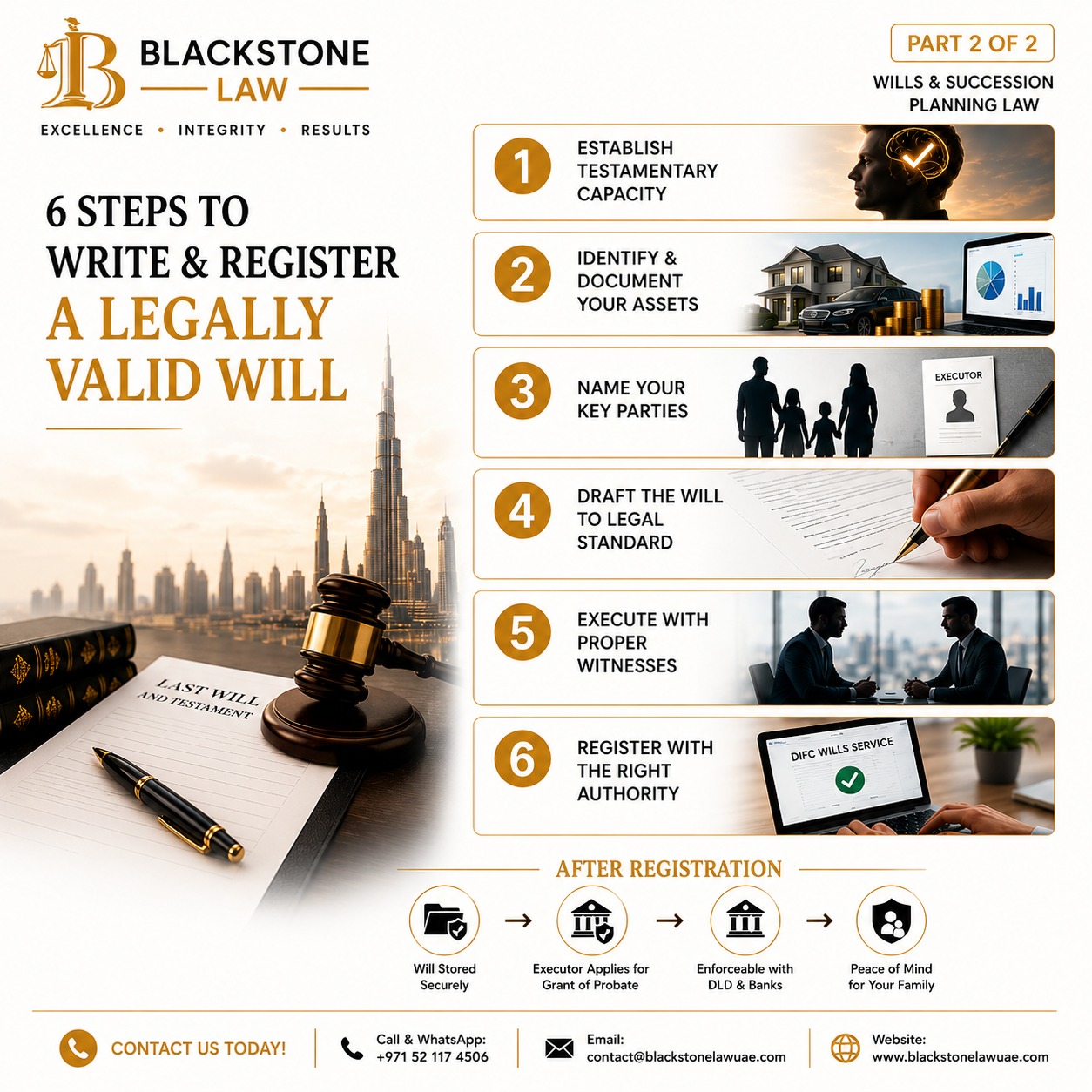
How to Write a Legally Valid Will in Dubai: A Step-by-Step Guide
Published by Blackstone Law UAE | Wills & Succession Planning Law
Step Two: Identify and Document Your Assets Clearly
Before drafting begins, compile a comprehensive inventory of all UAE-held assets. This should include real estate (with title deed numbers and DLD registration details), bank accounts and investment accounts (with full account details and institution names), company shareholdings or business interests (with company registration numbers and percentage ownership), vehicles, high-value personal property, and any digital assets including cryptocurrency.
The will should include a detailed asset list — local and international — beneficiary instructions, appointment of an executor, guardianship provisions for minor children, and specific inheritance wishes.
Precision matters at every level. A property described only as "my apartment in Dubai" creates ambiguity if you own more than one. A bank account described as "my savings account at Emirates NBD" is insufficient if you hold multiple accounts at the same institution. The more specifically each asset is identified, the less room there is for misinterpretation, dispute, or a court being unable to match the will's language to a specific asset.
For broader inheritance and estate planning support, visit our Wills & Succession Planning practice area.
Step Three: Name Your Key Parties — Beneficiaries, Executor, and Guardians
A legally valid will must clearly identify three categories of people: your beneficiaries, your executor, and — if you have minor children — your guardian appointees.
Beneficiaries are those who will inherit your assets. They must be identified by full legal name, relationship to you, nationality, and — where possible — passport number or Emirates ID.
Beneficiaries can be family members, friends, charitable organisations, or any other people or institutions. For non-Muslim testators under the DIFC framework, there are no legally mandated shares — you decide the distribution entirely, whether by percentage, specific asset allocation, or a combination of both.
The executor is the person who will manage and distribute your estate after your death. The executor's duties include gathering and valuing assets, paying any debts and taxes, and distributing the remaining assets to the beneficiaries as specified in the will.
Choose someone who is organised, trustworthy, and — ideally — familiar with the UAE legal and banking system. A beneficiary can be appointed as executor, but it is advisable to also name a substitute executor in case your first choice is unable or unwilling to serve.
Guardians are essential if you have minor children living in the UAE. If the testator has minor children, they should ideally appoint either permanent or interim guardians. In the absence of this decision, the courts announce the guardians as per the law, which may not be consistent with the testator's wishes and preferences.
The DIFC Full Will and Guardianship Will both allow you to name interim guardians — who step in immediately after your death — and permanent guardians, who assume ongoing responsibility.
If you are planning for family protection and guardianship matters, our Family & Personal Law team can also assist with related legal guidance.
Step Four: Draft the Will to Legal Standard
This is the stage where professional assistance stops being advisable and becomes essential. Drafting a will without legal expertise is risky. Each UAE authority requires specific formatting, registration procedures, and witness rules. A mistake, even a minor one, can invalidate your will.
A registered will draftsman — specifically one listed on the DIFC Wills Service's Register of Will Draftsmen — will ensure that the document meets all formatting, content, and legal-compliance requirements of the chosen registry.
For DIFC wills, this means compliance with the DIFC Wills and Probate Registry Rules. For Dubai Courts wills, it means the document must be in Arabic or include a certified Arabic translation.
Key drafting principles to ensure the will's enforceability include:
- Stating clearly that you are of sound mind and not under duress
- Explicitly stating that Sharia law should not apply to the distribution of your estate
- Avoiding any provision contrary to UAE public order or morality
- Ensuring assets are described with sufficient specificity
The draft should also address residuary estate — what happens to any assets not specifically named in the will.
You can review official DIFC guidance through the DIFC Courts Wills Service.
Step Five: Execute the Will with Proper Witnesses
Once the draft is finalised and approved, the will must be formally executed — signed in a specific, legally required manner.
The will must be signed by the testator in front of two adult witnesses who are not beneficiaries of the will, and the testator's signature must be verified by the witnesses' signatures.
The witness requirements are precise and unforgiving. Witnesses must be at least 21 years of age and must have with them a valid passport, Emirates ID, or any other government-issued photographic ID when attending the appointment.
Crucially, witnesses must not be beneficiaries or guardians, or spouses of beneficiaries or guardians, named in the will.
Choosing a witness who is also a beneficiary is one of the most common and most costly mistakes in will execution.
For DIFC wills, the execution takes place either in person at the DIFC Courts Wills Service Centre or online through video conference registration.
Step Six: Register with the Appropriate Authority
A signed will that has not been formally registered with an approved UAE authority is not enforceable.
Registration is what transforms a signed document into a legally binding instrument that UAE courts, banks, and government entities will act upon.
This typically involves registering the will with one of the official platforms — DIFC, ADJD, or Dubai Courts — and complying with the legal requirements of the relevant jurisdiction.
DIFC Registration
For DIFC registration, the finalised will is uploaded to the DIFC Wills Service online portal, a registration appointment is booked, the testator and two witnesses attend, and the will is signed and witnessed in the presence of a DIFC officer.
Once signed, your will is registered digitally. The DIFC Wills Registry holds it in electronic form.
After registration, your will is legally enforceable under DIFC rules.
ADJD Registration
For ADJD registration in Abu Dhabi, the process operates through the TAMM platform and covers assets across all UAE emirates.
Dubai Courts Registration
For Dubai Courts registration, the fee is considerably lower, but the process is conducted in Arabic and probate proceedings may be more complex for non-Arabic-speaking families.
The Mistakes That Invalidate Wills — and How to Avoid Them
Conflicting Documents
Before registration, ensure your will does not conflict with any existing power of attorney documents or home-country wills that cover different assets.
Using a Foreign Template
Copy-pasting clauses from a UK or US will template and submitting it in the UAE is a reliable way to create an unenforceable document.
Failing to Update After Life Changes
Most people with a will do not review it when they marry or divorce, give birth to or adopt children, appoint or change guardians, or when a beneficiary dies.
Making Informal Amendments
Amendments must be registered formally through the DIFC Wills Service Centre.
Overlooking Digital Assets
The DIFC now supports a Digital Assets Will for cryptocurrency and other digital holdings in non-custodial wallets.
After Registration: What Happens to Your Will
Once registered, your will is stored electronically by the DIFC Courts. Your executor should know where to access it.
After your death, the executor applies for a Grant of Probate from the DIFC Courts, submitting the death certificate and asset details.
Under Dubai Law No. 2 of 2025, the resulting probate order can be enforced directly with the Dubai Land Department and UAE banks.
Keep a copy of your will securely and ensure your executor knows it exists, where it is registered, and how to begin the probate process.
Let Blackstone Law UAE Draft Your Will Correctly
Writing a will in Dubai is not complicated when you have the right guidance. What it is, without exception, is consequential.
At Blackstone Law UAE, our will drafting lawyers in Dubai work with both Muslim and non-Muslim clients across every asset type and family structure.
We advise on the right registration framework, draft documents that are precisely tailored to your estate and wishes, manage the DIFC or Dubai Courts registration process from start to finish, and ensure your UAE will is coordinated with any existing international succession planning.
Contact Blackstone Law UAE today for a will drafting consultation. Get it done properly — once — and give your family the protection they deserve.
Frequently Asked Questions
Can expats write a legally valid will in Dubai?
Yes. Non-Muslim expats can register wills in Dubai through DIFC Courts, Dubai Courts, or other approved UAE authorities.
What makes a will legally valid in the UAE?
A legally valid will must comply with UAE registration, drafting, witnessing, and execution requirements.
Can a DIFC Will cover UAE property and bank accounts?
Yes. DIFC Wills can cover real estate, bank accounts, investments, business interests, and guardianship provisions.
Do I need witnesses to register a will in Dubai?
Yes. Two adult witnesses who are not beneficiaries or guardians under the will are generally required during execution.
Blackstone Law UAE | Wills & Succession Planning Law | Dubai, United Arab Emirates
Call & WhatsApp: +971 52 117 4506 | Email: contact@blackstonelawuae.com | Website: www.blackstonelawuae.com
Disclaimer: This article is intended for general informational purposes only and does not constitute legal advice. Laws and regulations are subject to change. Please consult a qualified legal professional regarding your specific circumstances.