How to Recover Money Owed to You in Dubai: Legal Guide UAE
Step-by-step guide to legally recovering a debt in Dubai — from the formal demand notice and precautionary attachment through civil claim and execution proceedings.
Debt Recovery | Published by Blackstone Law UAE
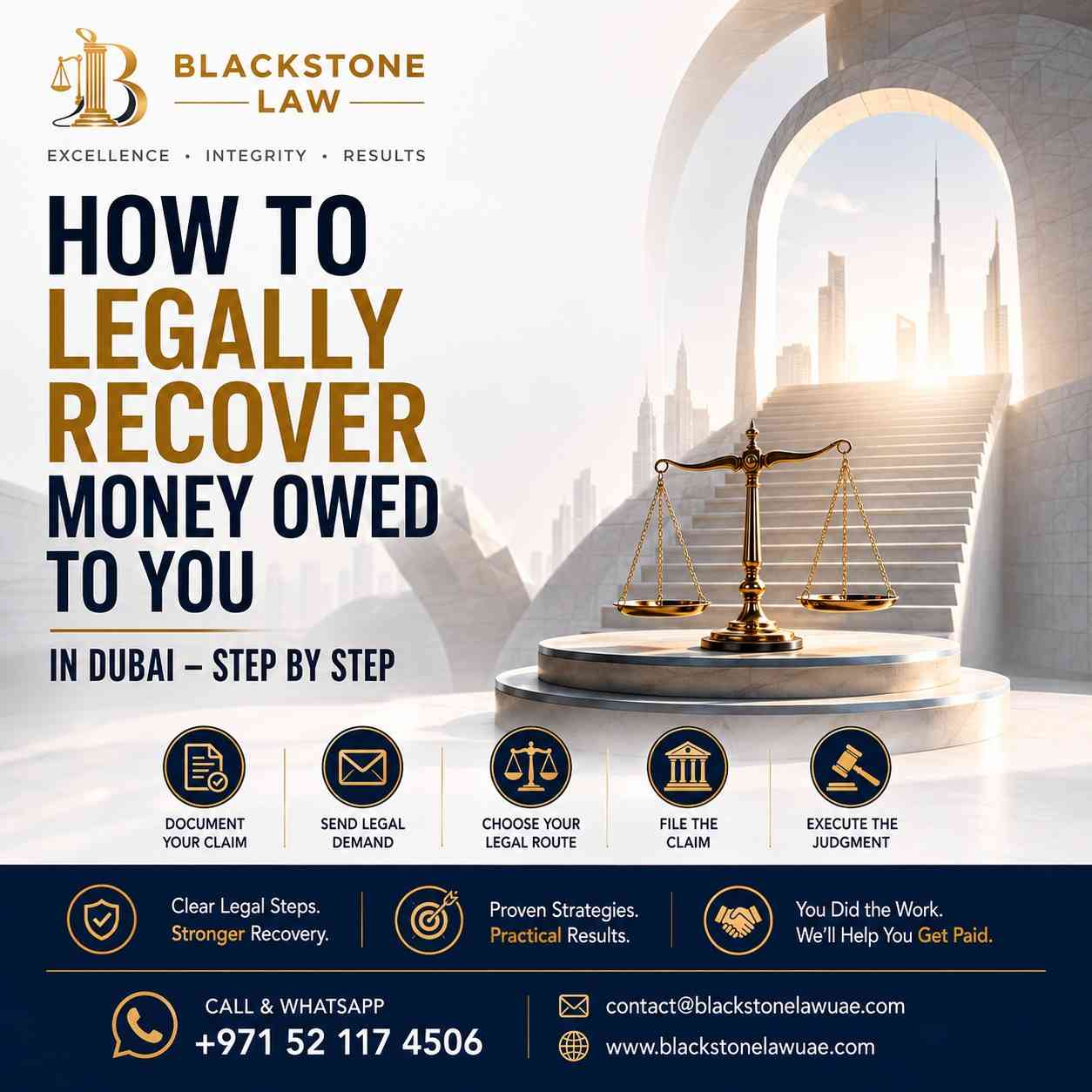
How to Legally Recover Money Owed to You in Dubai — Step by Step
You did the work. You delivered the goods. You held up your side of the agreement completely. And now the other party simply is not paying. They ignore your calls, respond with vague promises, and seem to be hoping you will go away. You will not. But you also need a clear, practical plan — not just frustration and a growing outstanding invoice.
Debt recovery in Dubai is governed by a clear legal framework, and creditors who follow the right steps in the right sequence have strong tools available. The UAE's court and execution systems, combined with its banking sector enforcement mechanisms, mean that a legitimately owed debt — properly documented — can be recovered through legal process. The key word is properly. How you handle the recovery process from the first demand letter to the final execution order determines how quickly, how completely, and how cost-effectively you get your money back.
Step 1: Document Your Claim Completely
Before any legal action, your case file must be complete and organised. The documents that form the foundation of any debt recovery claim in Dubai are:
- The signed contract or agreement
- Invoices with delivery confirmation
- Proof of services rendered or goods delivered (photographs, delivery notes, completion certificates, email confirmations)
- Correspondence showing the debt is acknowledged
- Any communications where the debtor has promised payment or requested additional time
The strength of your legal debt recovery position is directly proportional to your documentation quality. A creditor who can prove the obligation was created, the performance was completed, and the payment was due — with documentary evidence for each element — has a strong case. A creditor who relied on verbal arrangements and has minimal paperwork has a difficult one.
Step 2: Send a Formal Legal Demand Notice
Before filing any court claim, send a formal written demand — drafted by a debt recovery lawyer and sent by registered mail or notary — giving the debtor a final opportunity to pay before legal proceedings commence.
The formal notice should:
- Identify the specific debt (contract reference, invoice numbers, amounts)
- Confirm the basis for the obligation
- Specify the exact amount due, including any interest
- Give a clear deadline for payment (typically 7 to 15 days)
- State that legal proceedings will be initiated without further notice if payment is not received
A formal notice does three things: it creates a documented pre-action record that the court will expect to see; it sometimes produces payment without any further action; and it puts the debtor on notice of the seriousness of your intentions in a way that informal messages do not. Our pre-litigation demand and formal notices service drafts and issues this notice as the formal first step in every recovery case.
Step 3: Choose Your Legal Route
For debts above AED 200,000 with clear documentary evidence, the most effective legal route is often a civil court claim with a simultaneous application for precautionary attachment — freezing the debtor's bank accounts before they have the opportunity to move assets.
Precautionary Attachment
Precautionary attachment is one of the most powerful creditor tools in the UAE legal system. An application is made urgently to the Court of First Instance, without notice to the debtor, demonstrating a prima facie debt and a risk of asset dissipation. The court can order the debtor's bank accounts frozen within hours. With accounts frozen, debtors have a strong practical incentive to settle quickly.
Executive Instruments
Executive instruments apply where the debt arises from a returned cheque, a notarised acknowledgment of debt, or certain other documentary instruments. These allow direct application to the Execution Court without first obtaining a civil judgment — significantly faster than a full civil trial. For debts arising specifically from a bounced cheque, our dedicated guide on cheque bounce in the UAE covers this route in full detail.
Summary Judgment Procedures
Summary judgment procedures under Dubai Courts' rules allow straightforward commercial debt claims under AED 500,000 to be decided without a full trial — reducing time and cost significantly for clear-cut cases.
Choosing the correct route from the outset — rather than defaulting to standard civil litigation — is often the single biggest factor in how quickly a debt is recovered. Our formal legal proceedings and court action team assesses which route applies to your specific debt profile before any filing is made.
Step 4: File the Civil Claim
If the legal notice is ignored and direct recovery tools are not available, file a civil claim at the Dubai Court of First Instance. The claim includes a statement of facts and legal basis, the documentary evidence, the relief sought (principal amount, interest, costs), and the court fees — typically 2–6% of the claim value, with caps.
A litigation lawyer manages the filing process, ensures the claim is correctly drafted and translated, and manages the hearing schedule. For commercially sensitive claims, DIAC arbitration may be preferable to public court proceedings — particularly where the contract contains an arbitration clause. Our commercial litigation advisory team handles both court filings and arbitration submissions depending on which route best fits your contract and commercial relationship.
Step 5: Execute the Judgment
Obtaining a judgment is step one of recovery; actually recovering the money requires execution proceedings. The Execution Court has extensive powers:
- Bank account attachment
- Salary garnishment
- Property seizure and sale
- Vehicle impoundment
- Travel bans
An experienced debt recovery lawyer knows which execution tools produce results fastest for your specific debtor's asset profile. Effective execution requires knowing where the debtor's assets are — bank account details, property ownership records, vehicle registration, and company shareholding information are all relevant. Comprehensive execution planning before the judgment is obtained — not after — produces significantly faster recovery outcomes.
For creditors managing recovery across multiple debtors or a larger receivables book, our debt portfolio management service provides a structured, ongoing recovery process rather than a one-off engagement.
When Mediation Resolves It Faster
Not every debt dispute needs to proceed through formal litigation and execution. Where the debtor is willing to engage but disputes the amount, the timeline, or specific terms, structured mediation can produce a binding settlement far faster — and at a fraction of the cost — of full court proceedings. Our mediation for debt disputes service is frequently used as a parallel track alongside formal notice procedures, particularly in ongoing commercial relationships where preserving the business relationship has value alongside recovering the debt.
You did the work — we will help you get paid.
At Blackstone Law UAE, our debt recovery lawyers handle the full recovery process — from demand notices and precautionary attachments through civil litigation, judgment, and execution. Contact us today.
Book a Free Consultation WhatsApp UsFrequently Asked Questions — Debt Recovery in Dubai
What is the time limit to file a debt recovery claim in Dubai?
Commercial debt claims must generally be filed within 10 years. Employment-related debt claims must be filed within 2 years of termination. Specific limitation periods apply to certain claim types — take legal advice on your specific deadline promptly.
Can I recover interest on my outstanding debt?
Yes. The UAE courts award interest on commercial debts — typically at 9% per annum for commercial claims, running from the date of default. Your legal notice should specify that interest is accruing from the default date.
What if the debtor has gone out of business?
If the debtor company has been liquidated, recovery options depend on whether assets were properly distributed in liquidation. If the liquidation was improper or designed to defraud creditors, the directors may have personal liability. A debt recovery lawyer in Dubai advises on the specific recovery options available.
Is it possible to recover costs as well as the principal debt?
The Dubai Courts can award costs, but full cost recovery is not guaranteed. Partial cost recovery — a contribution toward legal fees — is the typical outcome. The recovery of costs is factored into your overall claim by your attorney.
What happens if the debtor has no UAE assets?
Enforcement against debtors with no UAE assets requires recognition and enforcement of the UAE judgment in the jurisdiction where the debtor's assets are located. A debt recovery attorney in Dubai advises on international enforcement options based on the specific country involved.
What is precautionary attachment in UAE debt recovery?
Precautionary attachment is an urgent application made to the Court of First Instance, without notice to the debtor, demonstrating a prima facie debt and a risk of asset dissipation. The court can order the debtor's bank accounts frozen within hours, creating a strong practical incentive for the debtor to settle quickly.
Related Services
- Pre-Litigation Demand & Formal Notices
- Formal Legal Proceedings & Court Action
- Mediation for Debt Disputes
- Out-of-Court Settlement & Negotiation
- Debt Portfolio Management
- Commercial Litigation Advisory
- Debt Recovery — Overview
Disclaimer: This article is intended for general informational purposes only and does not constitute legal advice. Laws and regulations are subject to change. Please consult a qualified legal professional regarding your specific circumstances.
Blackstone Law UAE | Debt Recovery | Dubai, United Arab Emirates | www.blackstonelawuae.com