Corporate Audit Dubai: What It Is & Why Every Business Needs
A corporate audit is no longer just a compliance checkbox in the UAE — it is a strategic business necessity. Learn what it covers, when it is required, and why proactive auditing saves far more than it costs.
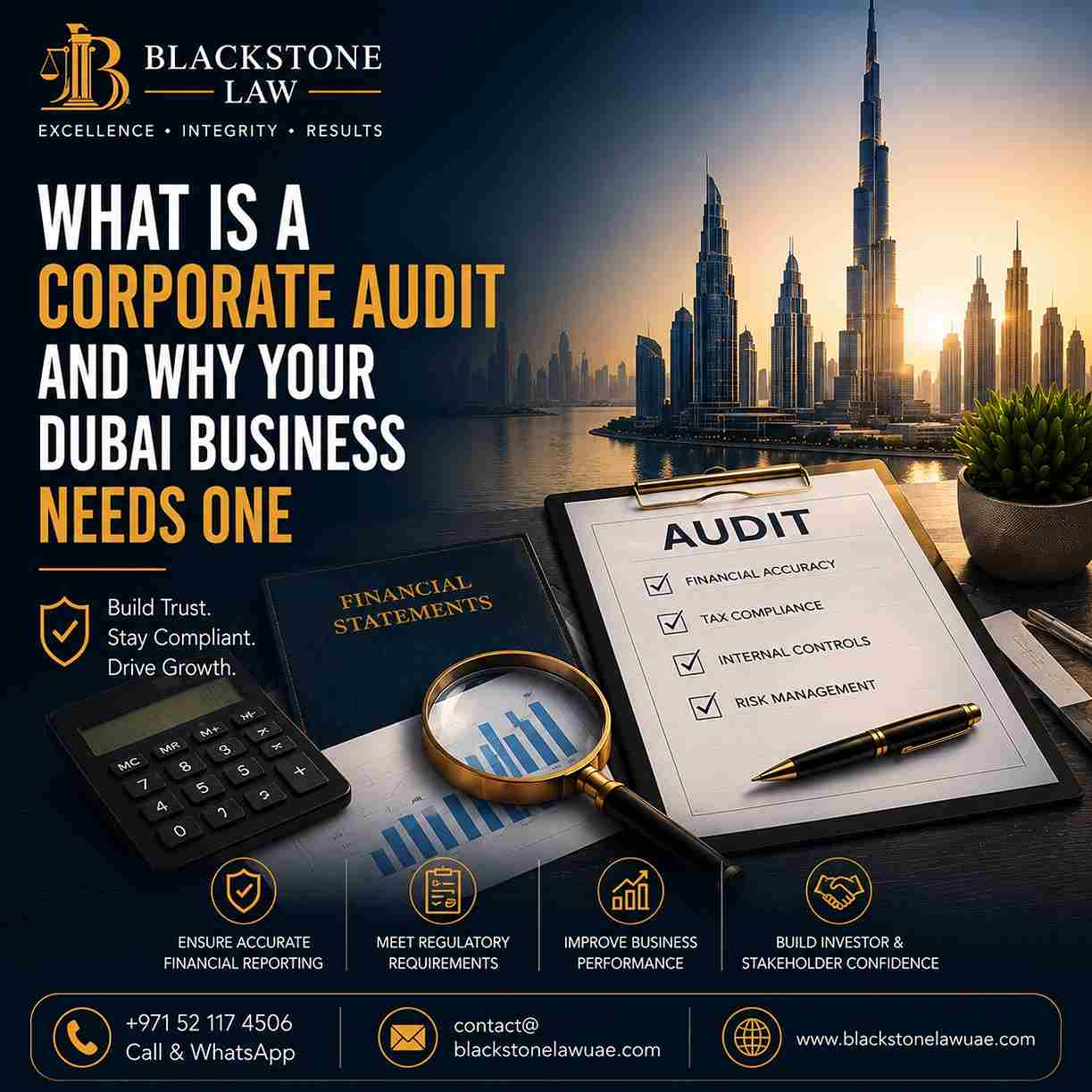
Audit & Advisory Services | Legal Audit | Published by Blackstone Law UAE
What Is a Corporate Audit and Why Does Your Dubai Business Need One?
A Dubai-based trading company was preparing to close a significant investment round. The prospective investor's due diligence team arrived with a detailed audit request list. Within two weeks, they had identified: three years of unreconciled intercompany transactions, a VAT position that had not been reviewed since initial registration, and an employment contract template that was non-compliant with the 2021 Labour Law reforms. The investment was delayed six months for remediation. What would have cost AED 30,000 to fix proactively cost AED 250,000 in delayed investment, additional legal fees, and management time diverted from operations.
Corporate audits in the UAE have shifted from a compliance necessity for listed companies to a strategic imperative for any serious private business. With corporate tax now in force, IFRS audit requirements applying to qualifying free zone entities, and investors and banking counterparties requiring audited financials as a matter of course, the question is no longer whether to conduct a corporate audit — but whether to do it proactively or reactively.
What a Corporate Audit Covers
A corporate audit is an independent examination of an organisation's financial statements, records, and operations to assess accuracy, compliance, and risk. In the UAE context, corporate audits divide into four main categories.
1. Financial Statement Audit
An independent examination of the company's financial statements — balance sheet, income statement, cash flow statement — to verify they present a true and fair view in accordance with applicable accounting standards (IFRS for most UAE businesses). The auditor issues an opinion on whether the financial statements are materially accurate. This is the audit most commonly required by banks, investors, regulatory authorities, and corporate tax compliance.
2. Corporate Tax Compliance Audit
An assessment of the company's corporate tax position — registration status, calculation methodology, documentation of deductions and exemptions, transfer pricing, and QFZP qualification status for free zone entities. This audit is particularly critical in the early years of UAE corporate tax implementation, when many businesses have made assumptions about their tax position that have not been formally tested. Our compliance advisory team conducts corporate tax reviews as a standalone engagement or alongside full financial audits.
3. Internal Controls Audit
An assessment of the financial and operational controls within the business — segregation of duties, approval processes, asset management, fraud prevention mechanisms, and management information quality. Weak internal controls are the most common precursor to both financial fraud and inadvertent compliance failure.
4. Regulatory Compliance Audit
A review of the business's compliance with UAE regulatory requirements — VAT, ESR, AML/CFT, labour law, data protection, and sector-specific regulations. Identifies gaps and prioritises remediation before regulators identify them first. This connects directly to our 2025 UAE business compliance checklist — the seven regulatory areas every UAE business must address.
When UAE Businesses Must Have an Audit
Free Zone Companies Claiming QFZP Status
Under the UAE corporate tax regulations, Qualifying Free Zone Persons must prepare IFRS-audited financial statements. This is a mandatory requirement — non-compliance risks loss of QFZP status, triggering 9% corporate tax on all income. For free zone businesses claiming the 0% rate, the audit is not optional. Our legal audit team assesses QFZP qualification status as part of every free zone audit engagement.
Companies Above the Small Business Relief Threshold
Businesses with revenue exceeding AED 3 million must maintain adequate financial records and will need to support their corporate tax return with audited or at least reviewed financial statements.
Companies Seeking Bank Financing
UAE banks universally require audited financial statements — typically two to three years — for any material financing application, whether for working capital facilities, property financing, or project finance.
Companies Seeking Investment
Private equity, venture capital, and strategic investors expect audited financials as a baseline. Unaudited statements create uncertainty that directly affects valuation and deal probability. Our transaction advisory team works alongside our audit team to ensure businesses are investment-ready before approaching investors.
Regulated Sector Companies
Banking, insurance, investment management, healthcare, and certain other sectors have mandatory audit requirements set by their regulatory authorities — UAE Central Bank, DFSA, DHA — regardless of company size.
The Business Case for Proactive Auditing
Beyond mandatory requirements, there is a compelling business case for audit services in Dubai on a proactive, annual basis.
Fraud Detection and Prevention
Small businesses are disproportionately vulnerable to internal fraud — the audit process identifies anomalies that management may not detect and creates deterrence through visibility.
Management Information Quality
Many UAE SMEs operate on accounting records that contain errors, classification issues, and reconciliation gaps. An audited set of accounts is reliable management information — not just a compliance document.
Transaction Readiness
Whether you are contemplating a sale, a merger, a new investor, or a bank refinancing, having clean audited accounts significantly accelerates the process and removes a major uncertainty from due diligence. Our commercial due diligence team regularly encounters businesses whose transactions are delayed months by the absence of audit-ready records.
Regulatory Readiness
The FTA's corporate tax audit and inspection programme is active. A business that maintains audit-ready records is significantly better positioned if selected for FTA review than one that scrambles to produce documentation only after a notice arrives.
The Audit Process in Practice
A standard financial statement audit for a UAE SME follows this sequence:
- Engagement letter and scope agreement
- Auditor access to financial records, bank statements, and supporting documentation
- Analytical review and testing of key balances and transactions
- Confirmation of balances with third parties (banks, debtors, creditors)
- Management representation letter
- Draft accounts review with management
- Management letter identifying control weaknesses and recommendations
- Audit opinion issuance
For a well-maintained business, the process takes two to four weeks. For businesses with incomplete records, the process is longer and more expensive — another argument for maintaining continuous compliance rather than producing records only when an audit is required.
Our corporate client advisory team also provides ongoing advisory support following the management letter — ensuring identified gaps are remediated effectively, not simply noted and filed.
Audit Services and the Wider Legal Picture
For many UAE businesses, the findings of a corporate audit trigger legal action — whether that is updating employment contracts to comply with the 2021 Labour Law reforms, correcting corporate governance frameworks to align with the updated Commercial Companies Law, or restructuring intercompany arrangements to address transfer pricing documentation requirements.
Blackstone Law UAE's audit and advisory team works alongside our corporate, employment, and tax legal teams to ensure audit findings translate directly into remediation — not just a report. Our corporate governance framework service specifically addresses the governance gaps most commonly identified in UAE business audits.
An audit is not a cost — it is the foundation of a trustworthy, transaction-ready business.
Blackstone Law UAE provides corporate audit and advisory services for businesses across all sectors — financial statement audits, corporate tax compliance reviews, internal controls assessments and regulatory compliance audits. Contact us today.
Book a Free Consultation WhatsApp UsFrequently Asked Questions — Corporate Audit in Dubai
Is a financial audit legally required for all UAE companies?
Not universally, but the scope of mandatory audit has expanded significantly. QFZP free zone entities, companies above certain revenue thresholds, regulated sector entities, and companies seeking bank financing all effectively require audited accounts. Many others will find audited accounts required by commercial counterparties even where not technically mandated by law.
What accounting standard applies to UAE company audits?
IFRS (International Financial Reporting Standards) is the applicable standard for most UAE entities. Full IFRS applies to listed and qualifying entities; IFRS for SMEs may apply to smaller private entities. Your auditor advises on the applicable standard for your specific situation.
How much does a corporate audit cost in Dubai?
Audit fees vary by company size, complexity, and sector. For a small to medium UAE business with annual revenue up to AED 10 million, audit fees typically range from AED 10,000 to AED 30,000. Larger or more complex entities command higher fees. Blackstone Law UAE provides a fixed fee quote after reviewing your business profile.
What is the difference between a financial audit and a corporate tax review?
A financial statement audit expresses an opinion on whether the accounts present a true and fair view in accordance with IFRS. A corporate tax review assesses the accuracy and completeness of the corporate tax position — deductions, exemptions, QFZP status, and transfer pricing. Both are often conducted together but address different questions.
Do free zone companies in the UAE need to be audited?
Free zone companies claiming QFZP status under UAE corporate tax regulations must prepare IFRS-audited financial statements as a mandatory requirement. Non-compliance risks loss of QFZP status, triggering 9% corporate tax on all income. Many free zone authorities also require annual audited accounts as a condition of licence renewal.
Related Services
- Legal Audit
- Compliance Advisory
- Transaction Advisory
- Corporate Client Advisory
- Corporate Governance Framework
- Commercial Due Diligence
- Audit & Advisory Services — Overview
Disclaimer: This article is intended for general informational purposes only and does not constitute legal, accounting, or tax advice. Laws and regulations are subject to change. Please consult a qualified professional regarding your specific circumstances.
Blackstone Law UAE | Audit & Advisory Services | Dubai, United Arab Emirates | www.blackstonelawuae.com