Asset Protection Strategies for Expats Living in the UAE
For expats in the UAE, the most immediate legal risk to accumulated wealth comes from an unexpected direction:
Wills & Succession Planning | Private Client Advisory | Published by Blackstone Law UAE
Asset Protection Strategies for Expats Living in the UAE
Here is a question worth sitting with: you have spent years building your life in the UAE — the apartment, the savings, the business stake, the investments. If something happened to you tomorrow, how much of that would actually reach the people you built it for?
For most expats in the UAE, the honest answer is: far less than they think. Assets get frozen. Accounts are blocked. Courts apply default rules that have nothing to do with your intentions. In 2025, Dubai attracted 9,800 new millionaires — confirming its position as the world's top wealth migration destination. But accumulating wealth and protecting it are two different disciplines. This article covers the legal strategies that actually work for expats in the UAE, and why acting sooner matters far more than most people realise.
The Risk You Are Probably Not Thinking About
For expats in the UAE, the most immediate legal risk to accumulated wealth comes from an unexpected direction: the default application of inheritance and succession rules when no formal structure is in place. Without a valid will, assets can be distributed according to Sharia law, potentially conflicting with personal wishes. Bank accounts — including joint accounts — can be frozen and property not transferred to your chosen beneficiary until legal formalities are completed.
The 2022 reforms improved the default position for non-Muslims, but even the improved default takes all flexibility away. You cannot leave assets to a close friend, a stepchild, a business partner, or a charity. You cannot specify how your company shareholding is handled. You cannot appoint your children's guardians.
Asset protection in the UAE is not just about avoiding bad outcomes — it is about retaining the ability to decide good ones.
Understanding why every expat in the UAE needs a registered will is the essential starting point for any asset protection strategy.
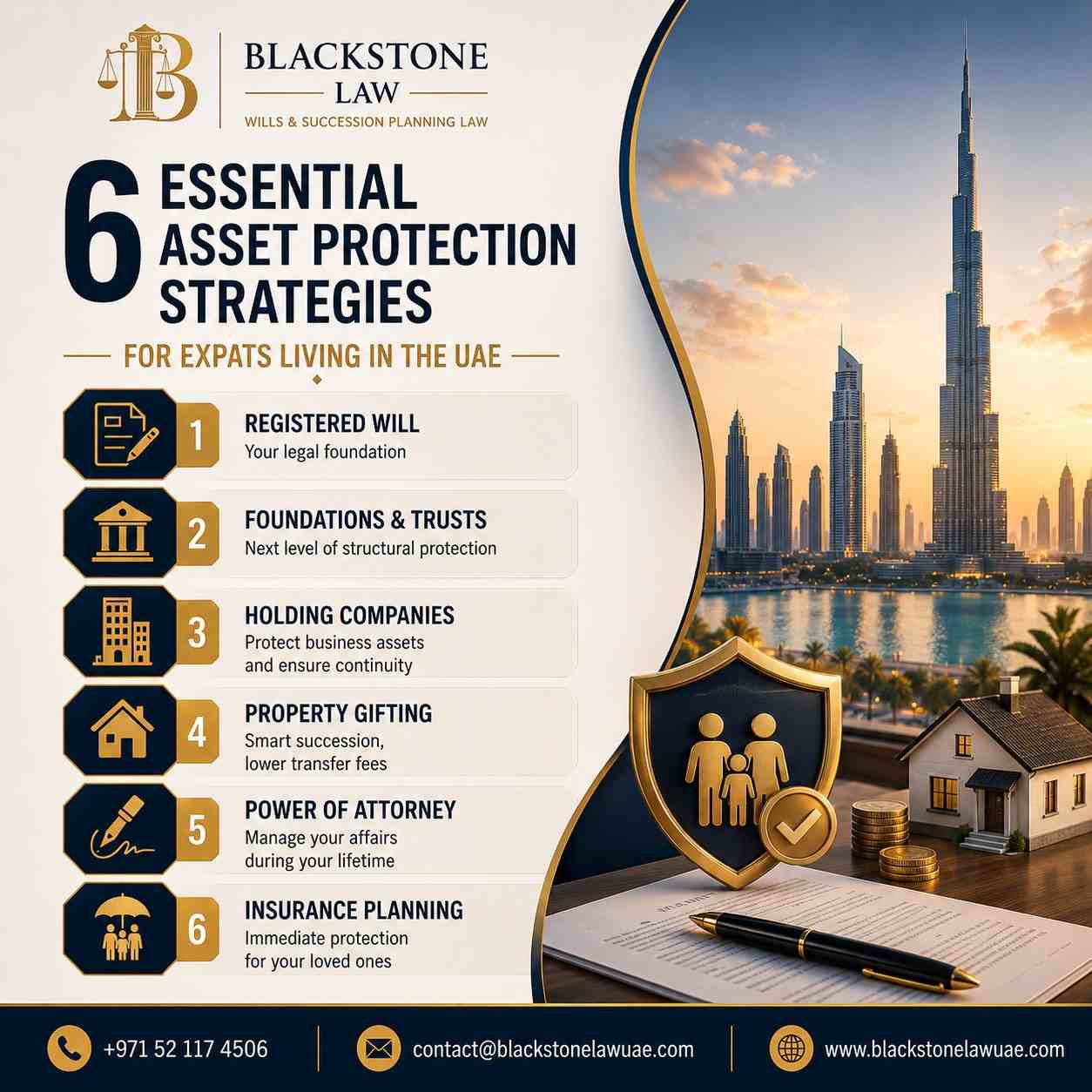
Strategy 1: Register a Will — Your Legal Foundation
Every other asset protection strategy in the UAE sits on top of this one. A registered will is not an optional add-on; it is the legal foundation that makes everything else work. For serious non-Muslim expat families in the UAE, registering a DIFC or ADGM Will has become a mandatory part of establishing a UAE presence — where this step is skipped, assets and bank accounts are routinely frozen until courts determine succession.
The DIFC Wills Service Centre allows non-Muslim expatriates to distribute assets freely under English common law principles. Under Dubai Law No. 2 of 2025, DIFC-registered wills carry direct enforcement authority with the Dubai Land Department and UAE banks — no additional court proceedings required to unlock assets after death. For Abu Dhabi assets, the ADJD Wills Registry offers equivalent coverage across all seven emirates.
A Full DIFC Will covers real estate, bank accounts, business shareholdings, investment portfolios, digital assets, and guardianship of minor children under a single document. For parents not yet ready to tackle the full estate, a standalone Guardianship Will can be registered immediately to protect children's care arrangements as a first step.
Strategy 2: Foundations and Trusts — Structural Asset Protection
For expats with more complex estates — multiple properties, business interests, multi-jurisdictional assets, or significant investment portfolios — a registered will alone may not provide the full protection needed. This is where foundations and trusts come in.
The DIFC Foundation offers privacy, protection, and flexibility — serving as an effective alternative to probate. By centralising ownership and defining clear succession rules within its By-Laws, it avoids the need for assets to pass through court-administered probate processes upon the founder's death, ensuring immediate continuity of asset management without complex legal procedures.
Because the foundation owns the assets in its name, they are generally shielded from personal claims against the founder or beneficiaries — including divorce proceedings and creditor claims. UAE courts in DIFC and ADGM will not apply foreign forced heirship rules to assets held in a foundation, meaning the founder's wishes can override the mandatory inheritance splits that might otherwise apply.
Foundations can be established in DIFC, ADGM, or RAK ICC. A well-structured DIFC Foundation works best combined with a DIFC Will — the foundation holds and manages assets, while the will provides instructions for distribution and guardianship. Our private client advisory team advises on the right structure for your asset profile.
Strategy 3: Holding Companies for Business Asset Protection
If you own shares in a UAE Free Zone or Mainland company, those business interests are part of your estate — exposed to the same succession risks as your personal assets. Without proper structuring, shares can be subject to Sharia inheritance rules: a business you built can be frozen, disputed, or transferred to heirs who have no interest in running it, while ongoing operations stall.
Transferring business shareholdings into a holding company — established in DIFC, ADGM, or RAK ICC — creates legal separation between your personal estate and your business assets, offering:
- Asset isolation from personal claims and succession disputes
- Confidentiality over ultimate beneficial ownership
- Governance clarity for multi-shareholder structures
- Succession control following your registered will, not UAE default rules
A DIFC Business Owners Will — covering up to five company shareholdings — works in conjunction with a holding structure to provide seamless succession without court intervention. Our corporate legal services team structures holding arrangements that align with both your business governance and your estate plan.
Strategy 4: Property Gifting as a Succession Tool
One of the most underutilised asset protection strategies for expats in Dubai is property gifting — transferring real estate to immediate family members during your lifetime rather than leaving it to pass through your estate on death.
The Dubai Land Department facilitates gifting to first-degree relatives at a reduced transfer fee of 0.125%, compared to the standard 4% on sales. The transfer is completed during your lifetime — no probate, no estate freeze, no court involvement. With no gift or inheritance tax in the UAE, it is one of the most cost-efficient family asset management tools available.
There are limitations to be aware of:
- Non-UAE nationals can only gift within designated freehold zones (Palm Jumeirah, Downtown Dubai, Dubai Marina, and others)
- Mortgaged or off-plan properties cannot be gifted until the title deed is clear
For expats with freehold property in Dubai, gifting to a spouse or children is a powerful tool to use alongside — not instead of — a registered will. Our real estate legal team advises on structuring gifting transactions correctly.
Strategy 5: Power of Attorney — Protecting Your Affairs During Your Lifetime
Asset protection is not only about what happens after you die — it is also about what happens if you are incapacitated or abroad and unable to manage your UAE affairs. A properly drafted Power of Attorney (POA) ensures someone trusted can manage your property transactions, bank accounts, business decisions, and dealings with UAE government authorities on your behalf.
Following DLD Circular No. 29/R/2025 issued in July 2025, all POAs used in real estate dispositions must undergo mandatory electronic verification and contain transaction-specific wording — making professional drafting more critical than ever. A generic or outdated POA may not be accepted.
Think of the POA as the companion to your will: it manages your affairs while you are alive but unavailable; the will takes over when you are not. Our Power of Attorney drafting team prepares UAE-compliant POAs that meet the current DLD and notary requirements.
Strategy 6: Insurance and Designated Beneficiaries
Life insurance and pension plans are often the largest financial assets an expat accumulates in the UAE — and yet they are frequently overlooked in estate planning. A policy with no named beneficiary may be treated as part of your general estate, subject to the same freeze and court process as all other assets. A policy with a clearly named beneficiary, by contrast, passes directly outside probate, providing immediate liquidity exactly when your family needs it most.
Review your life insurance and pension beneficiary designations as an integrated part of your estate plan — not as a separate financial exercise. For expats with assets in multiple countries, a Private Placement Life Insurance (PPLI) policy can bypass probate in both the UAE and the home country, paying out directly to beneficiaries or a trust.
Putting It All Together: An Integrated Approach
No single strategy provides complete protection on its own. The most robust plans combine multiple layers:
- ✅ A registered will as the legal foundation
- ✅ A DIFC Foundation or holding structure for complex or high-value assets
- ✅ Property gifting where freehold property qualifies
- ✅ A current, DLD-compliant Power of Attorney for lifetime management
- ✅ Updated insurance beneficiary designations for immediate liquidity
The UAE now offers one of the most sophisticated legal toolkits for expat asset protection anywhere in the world. The question is not whether the tools exist — it is whether you have used them.
Our private client advisory and wills and succession planning teams work together to build integrated protection strategies tailored to your specific asset profile.
What you have built deserves the protection it has earned.
Contact Blackstone Law UAE today for a confidential asset protection consultation.
Book a Free Consultation WhatsApp UsFrequently Asked Questions: Asset Protection for UAE Expats
Does the UAE have inheritance tax?
No. The UAE imposes no inheritance tax, estate tax, or capital gains tax. The legal fees for setting up a will, foundation, or holding structure are the primary costs of protecting your estate — and they are one-time rather than ongoing charges.
Does my home country will protect my UAE assets?
Not reliably. Foreign wills are not automatically enforceable in the UAE and may be treated as having no legal effect on UAE-situated assets. A locally registered will through the DIFC Wills Service Centre, ADJD, or Dubai Courts is the only dependable protection for UAE-based assets.
I jointly own property with my spouse in the UAE. Are we automatically protected?
No. The UAE does not apply survivorship rules to jointly owned property. Without a registered will or alternate structure, the deceased's share may be frozen and distributed through the UAE court process — regardless of joint ownership.
Can a non-resident with UAE property use the DIFC Will system?
Yes. Non-residents with property, bank accounts, or business interests in Dubai or Ras Al Khaimah can register a DIFC Will remotely via secure video conference — no UAE residency is required.
What is the difference between a DIFC Foundation and a UAE will?
A will controls how assets are distributed after death. A DIFC Foundation provides structural protection both during your lifetime and after — separating legal ownership from your personal estate, shielding assets from creditor claims and forced heirship rules, and enabling continuity without probate. For most expat families, the two work together: the foundation as the structure, the will as the instruction manual.
Can I gift property to my children in Dubai to avoid probate?
Yes, subject to conditions. The Dubai Land Department allows gifting of freehold property to first-degree relatives at a reduced transfer fee of 0.125%. The transfer happens during your lifetime, bypassing probate entirely. Non-UAE nationals can only gift within designated freehold zones, and mortgaged or off-plan properties cannot be gifted until the title is clear.
What happens to my business shares in the UAE if I die without a will?
Without a registered will or holding structure, your UAE business shareholdings are subject to UAE succession law. Shares can be frozen, disputed, or transferred to heirs with no business interest, stalling operations. A DIFC Business Owners Will or holding company structure prevents this by ensuring succession follows your documented wishes.
Disclaimer: This article is intended for general informational purposes only and does not constitute legal advice. Laws and regulations are subject to change. Please consult a qualified legal professional regarding your specific circumstances.
Blackstone Law UAE | Wills & Succession Planning | Dubai, United Arab Emirates | www.blackstonelawuae.com